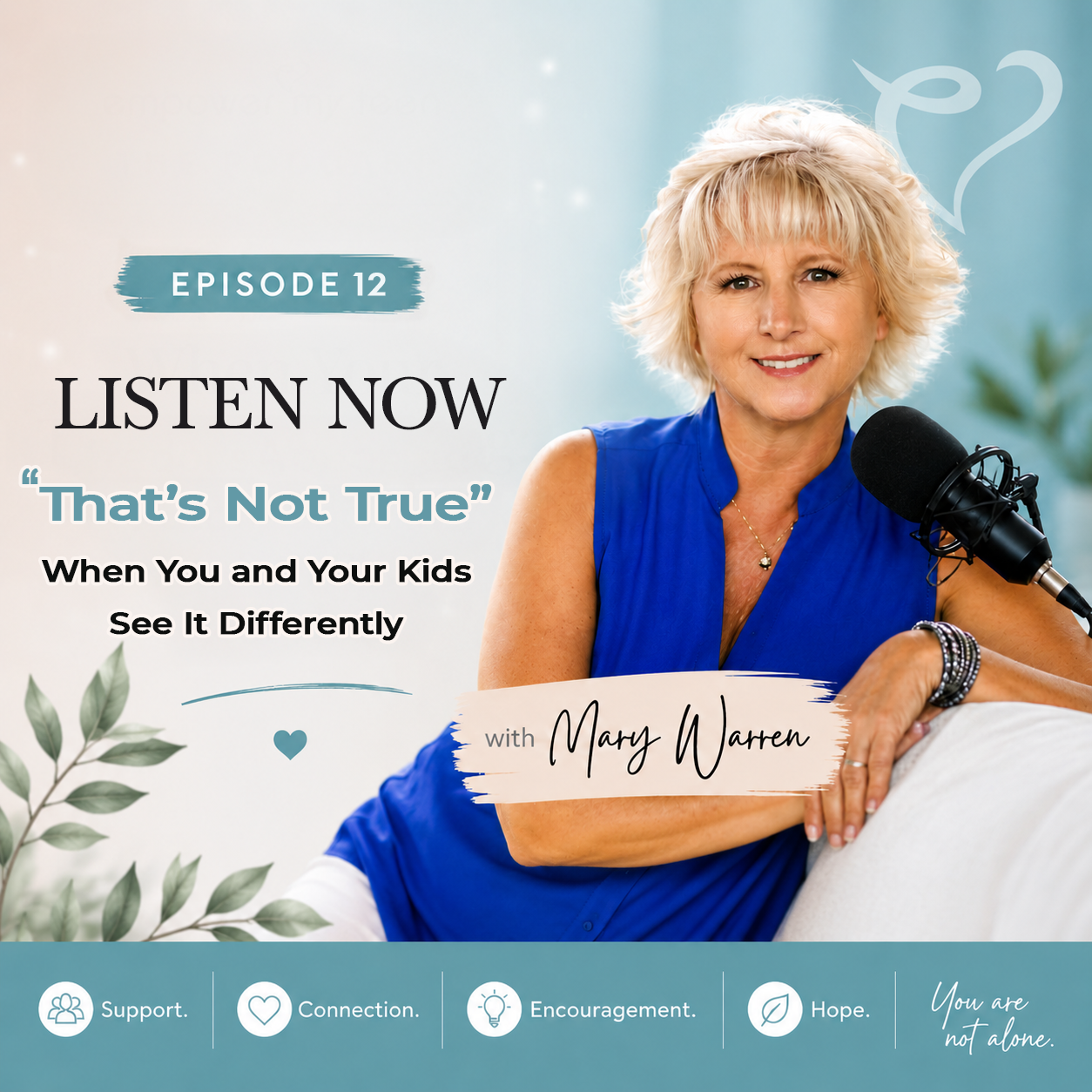

Have you ever had your child say something to you and immediately thought…
“That’s not true”?
“You don’t trust me.”
“You never do anything for me.”
“You don’t love me.”
As parents, our instinct may be to start explaining all the reasons they’re wrong.
But what if we waited for just a moment before responding?
In this episode of Empower My Teen, I’m talking about what happens when you and your child see the same situation completely differently.
We all have our own feelings, perceptions, and experiences, but that doesn’t mean everything we feel or believe is necessarily a fact.
Sometimes your child may have a point you haven’t considered.
Sometimes you may know that what they’re saying simply isn’t factually true.
And sometimes there may be a little truth on both sides.
Instead of immediately deciding who is right, what might happen if we became curious first?
A simple…
“Tell me more about that.”
…may give you a chance to understand why your child sees the situation the way they do.
You may hear something you hadn’t considered. Or you may listen to everything they have to say and still disagree.
Being curious about their perspective doesn’t mean giving up your own.
Sometimes it matters less who is right or wrong and more that we stay in the conversation and stay connected.
Need Support?
If your teen is struggling and you’re unsure what to do next, schedule a complimentary consultation with me and talk about your family’s situation.
EPISODE TRANSCRIPT:
00:03
Have you reached the end of your rope trying to help your child? Are you wondering how to help your teen find their way back to themselves and you don’t know what to do next?
00:12
I’m your host, Mary Warren, and I’m here to share with you information, stories, and possible solutions to help you find the best options for your teen and family.
00:23
Are you ready to start thinking about parenting and relationships in a new way? If you are, take a breath, relax, and let’s talk.
00:35
Have you ever had your kid say something to you and you immediately thought, “That’s not true”?
00:41
And I’m talking about those statements that make us want to correct them before they’ve even finished the sentence. “You don’t trust me. You never do anything for me.
00:51
You don’t love me.” Because when we hear something like that, we don’t just hear what they’re saying. We immediately start thinking about why they’re wrong.
01:01
But they may believe what they’re saying just as strongly as we believe they’re wrong. So, whose truth is it? That’s the question I wanna talk about today.
01:10
Because we hear a lot about people having their truth, and I understand what we mean by that.
01:17
We all have our own feelings, perceptions, and experiences, but that doesn’t mean everything we believe or feel is a fact.
01:26
And I think that’s an important distinction when we’re raising teens and young adults.
01:30
Take, “You don’t trust me.” Your immediate response might be, “Of course I trust you.” But then you stop and really think about it. Do I? Trust may have been broken.
01:42
You may be checking up on them more than you used to or asking more questions because of the choices they’ve made.
01:48
Your kid experiences that as, “You don’t trust me.” You experience it as, “I’m being a parent. I’m trying to keep you safe.” So, whose truth is it? There may be truth in both.
02:02
Your kid is right that you don’t completely trust them right now, and you’re right that there’s a reason for that.
02:08
The problem comes when we get so focused on proving our version that we stop looking at what might be true in their version. Now, let’s take something completely different.
02:20
“You never do anything for me.” Really? As a parent, you might be thinking, “Are you kidding me?” Because you know that’s simply not true. You do things for this kid every day.
02:33
Some they see, and plenty they probably don’t see. So, in this case, there actually is a fact we can look at. “You never do anything for me” isn’t true. But your kid may believe it in that moment.
02:49
They’re angry you just said no to something they wanted. They’re frustrated. They may even be trying to make you feel guilty, so you’ll change your mind and say yes. Their feelings are real.
03:01
That doesn’t make the statement true. And I think this is where the idea of your truth and my truth can get a little messy because there aren’t always two different truths.
03:14
There can be a fact and two different reactions to it, and there can also be something in what our kid is saying that’s worth looking at.
03:23
That’s why I don’t think the answer is to agree with them automatically, but I also don’t think the answer is to say immediately, “That’s not true.” Because the minute we do that, we’ve decided that our version is the right one before we’ve even looked at theirs.
03:40
I think we can be curious without agreeing. If my kid says, “You don’t trust me,” I can ask myself whether there’s any truth to it.
03:49
If they say, “You never do anything for me,” I know that’s not factually true and still wonder why they’re saying it. Those are very different situations, and that’s the point.
04:00
We don’t have to treat everything our kids say as their truth and therefore something we can’t question.
04:07
We also don’t get to assume that because we’re the parent, our version is automatically the truth. We may be right. They may be right.
04:17
There may be a little truth on both sides, and what we’re arguing about may not really be truth at all. It may be how each of us feels about what happened.
04:28
So, when your kid says something and everything inside of you wants to respond, “That’s not true,” what would happen if you just waited a minute?
04:37
Not because they’re necessarily right, not because you’re necessarily wrong, but because you don’t know yet.
04:44
You might ask, “Why do you feel like I don’t trust you?” Or simply, “Tell me more about that.” And then listen.
04:52
You may hear something that makes you think, “Okay, I see why you feel that way.” You may also listen to the whole thing and think, “Nope, still don’t agree.” Both are okay.
05:05
The goal isn’t to decide that our kid’s version matters more than ours. It’s to be willing to look at both before deciding what we believe is true. So, whose truth is it?
05:18
I don’t think we always know right away, and maybe that’s the point. We don’t have to decide whose truth it is before we’ve taken the time to listen.
05:27
Because sometimes it matters less who’s right or wrong and more that we stay in conversation and stay connected. Thank you for listening today.
05:37
I’m your host, Mary Warren, and I’m so grateful you found this podcast. I invite you to visit my website at empowermyteen.com and schedule a complimentary consultation to discuss your situation.
05:51
Remember, you are a caring and concerned parent, and your child is lucky to have you in their life, so please be kind to yourself.