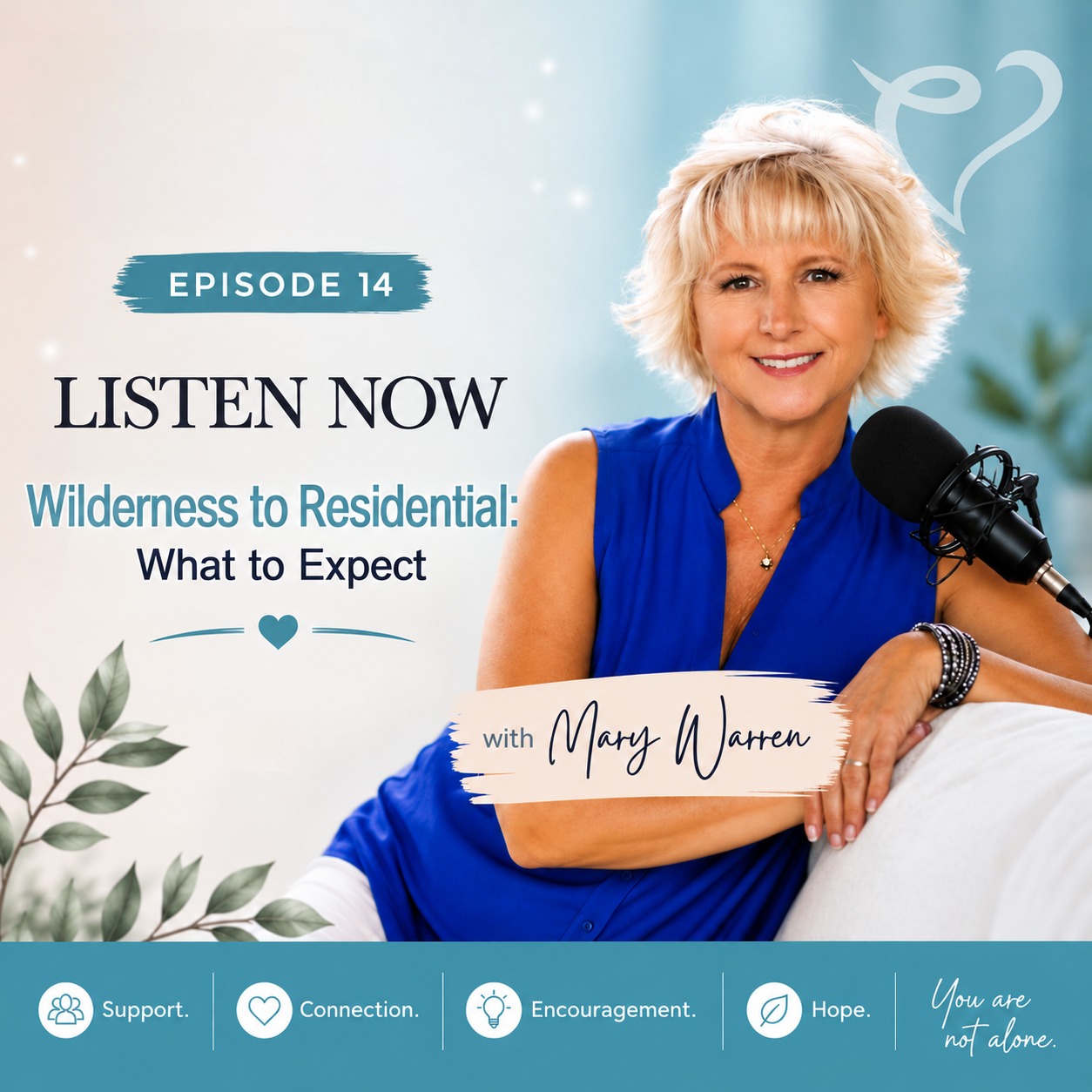

For years, I’ve described wilderness therapy as the emotional ER and residential treatment as physical therapy.
In this episode, I explain the difference between these two levels of care, what parents can expect during the transition, and why progress may look different along the way.
When you’ve already seen your child make positive changes in wilderness, it can be difficult to understand why they may still need residential treatment.
And sometimes the slower pace of residential treatment can leave parents wondering if their child is still making progress.
If you’re exploring treatment options for your teen or wondering what comes next, I hope this conversation brings you a little more clarity.
Listen now!
EPISODE TRANSCRIPT:
[00:00:00]
Have you reached the end of your rope trying to help your child? Are you wondering how to help your teen find their way back to themselves and you don’t know what to do next? I’m your host, Mary Warren, and I’m here to share with you information, stories, and possible solutions to help you find the best options for your teen and family.
[00:00:23]
Are you ready to start thinking about parenting and relationships in a new way? If you are, take a breath, relax, and let’s talk by the time a family starts considering a higher level of care, they’ve usually been dealing with one concern after another for a while. I sometimes describe it as playing Whac-A-Mole.
[00:00:46]
You focus on one thing, and then something else pops up. You think you’ve finally gotten one situation under control, and before you’ve had a chance to catch your breath, you’re dealing with something else. And, when that keeps
[00:01:00]
happening, you can spend so much time responding to what’s right in front of you that it becomes really difficult to sand back and see the bigger picture.
[00:01:09]
After a while, it can be hard to know where to even start. Eventually, you may reach a point where you realize your child needs more help than you can provide at home. That’s when a higher level of care might enter the conversation. What that looks like will depend on what your child needs. Two of the options, and the ones I’d like to talk about today, are wilderness therapy and residential treatment.
[00:01:35]
For years, I’ve explained the difference by calling wilderness therapy the emotional ER and residential treatment physical therapy. If these terms are new to you, wilderness is a short-term, highly structured level of care where your child steps away from everyday life for several weeks. They live outdoors in nature in a small group while working closely with staff and therapists.
[00:01:59]
Residential treatment is longer-term care where they live in a therapeutic setting while continuing therapy and school and working on what brought them to treatment. When your child enters wilderness, they can push pause on their life in many ways. The electronics and everyday distractions are now gone.
[00:02:17]
They live in a small group with staff around them and work closely with a therapist. For eight to fourteen weeks, they have the opportunity to slow things down and start looking beneath what’s been happening. Instead of focusing on the latest problem, we’re trying to understand what’s driving some of the behaviors you’ve been seeing.
[00:02:36]
That’s the why. What’s underneath things like the anger, the school issues, or the substance use? That’s what we’re trying to understand, and that’s where the emotional ER really begins. It’s all hands on deck. The therapist is getting to know your child, but they’re also trying to understand the bigger picture of what brought them to wilderness.
[00:03:00]
The staff is an important part of that too because they’re with your child every day. They see how they respond when things are hard and notice patterns that can give the therapist more information to work with. Sometimes psychological or educational testing may also be part of the process. But wilderness isn’t just about gathering information.
[00:03:20]
A lot of therapeutic work happens during those weeks too. With so many everyday distractions removed, your child has time to slow down and start looking at themselves and what’s been happening in their life. They have opportunities to process what they’ve been through, take accountability for the choices, and start to understand themselves a little differently.
[00:03:43]
Work is also happening with the family. Those relationships may have been strained for a really long time, and wilderness can create some space to begin working on them differently. At the same time, they’re beginning to use what they’re learning to understand themselves and their relationships a lot better.
[00:04:02]
The goal isn’t to have everything figured out and fixed in eight, 12, or 14 weeks. That’s not what an ER does. In an actual emergency room, the goal is to understand what’s happening, stabilize things, and decide what needs to happen next. That’s how I think about wilderness. By the end, we hopefully have a much clearer picture than we had when we started, and then comes the question: What does the child need next?
[00:04:33]
For some, the recommendation may be to return home. For others, what was uncovered during those weeks tells us they need more time and more support. When residential treatment is recommended, we move from the emotional ER into physical therapy. The job changes. The therapist’s role changes too. Not because one therapist does therapy and the other doesn’t.
[00:05:00]
They’re working with your child at different points in the process. By the time your child moves into residential treatment, we hopefully know more than we did when they entered wilderness. The residential therapist has information and recommendations from wilderness and the treatment team, but they also develop their own relationship with your child and their own understanding of them.
[00:05:21]
They can build on what we’ve already learned and go a lot deeper. And your child is taking the skills they started learning in wilderness and continuing to work on them in a much more normal setting. They’re back indoors. They’re going back to school. They’re around their peers and friends. There are more responsibilities and expectations.
[00:05:43]
Life starts to move at a faster pace again. But interestingly, the therapeutic process can feel slower. Wilderness can be intense and concentrated. A lot can happen in eight to fourteen weeks, and parents can sometimes see changes pretty quickly. Physical therapy is different. Now we’re taking what we uncovered in the emotional ER and going deeper.
[00:06:10]
Your child has to practice using those skills with more of everyday life happening around them. It’s one thing to slow down and talk about how you handle frustration. It’s another thing to use what you’ve learned when you’re trying to get schoolwork done, you’re having a problem with a peer, or something isn’t going the way you wanted.
[00:06:30]
And that’s where progress may not be as easy to see. The environment is moving faster, but the work itself can take more time. I know a little something about physical therapy because I went through it after hurting my rotator cuff. I remember doing those small exercises over and over and wondering, “How are they going to get my shoulder working again with just doing these?”
[00:06:54]
I didn’t see progress every day, but eventually something that had been difficult was a little easier. I could move my arm farther. I had more strength. The progress had been happening even when I couldn’t see it. And I think emotional progress can look a lot like that Your child may have a hard day. An old behavior may resurface.
[00:07:17]
They may know exactly what skill they’re supposed to use and still not use it. Knowing what to do and being able to do it when things get hard are two different things. Sometimes you don’t recognize your progress until you look back and realize something that used to be a real struggle isn’t quite as hard anymore.
[00:07:37]
That’s physical therapy. I think understanding the difference between the emotional ER and physical therapy can be really important for parents, because when the growth and healing feels slower, it can be easy to wonder if your child is still making progress or if wilderness even worked. But these two levels of care have different jobs.
[00:08:00]
Emotional ER creates the pause to begin understanding what’s happening and why. Physical therapy gives your child more time to take what they have learned and start using it as real life happens around them. And when we understand they’re doing different kinds of work, I think it becomes a little easier to be patient with the pace.
[00:08:19]
Not all progress is easy to see. Sometimes understanding that can change what we look for when we’re trying to see the progress.
[00:08:31]
Thank you for listening today. I’m your host, Mary Warren, and I’m so grateful you found this podcast. I invite you to visit my website at empowermyteen.com and schedule a complimentary consultation to discuss your situation.
[00:08:44]
Remember, you are a caring and concerned parent, and your child is lucky to have you in their life, so please be kind to yourself.